Your nonprofit likely publishes an annual report each year to update your community on the progress you’re making toward your mission goals through your projects and programs. However, amid growing donor distrust, these one-time publications aren’t enough to keep your supporters in the loop anymore.
According to the Give.org Donor Trust Report 2026: Trends in Donor Trust and Perspectives, 67.7% of respondents say trusting a charity is essential before donating, but only 18.3% report high trust in nonprofits. To strengthen trust among your donors, you need to provide immediate, tangible proof of supporters’ impact through real-time data reporting.
By integrating your nonprofit CRM with program data, you can create automated, rapid feedback loops that show donors exactly how you’re using their funds right after they give. Ultimately, providing this level of real-time financial transparency proves your organization's ROI and transforms skeptical contributors into loyal, long-term advocates.
Let’s explore four foundational tips to combat donor skepticism using real-time impact data.
1. Connect transactions to real-world outcomes with visual proof.
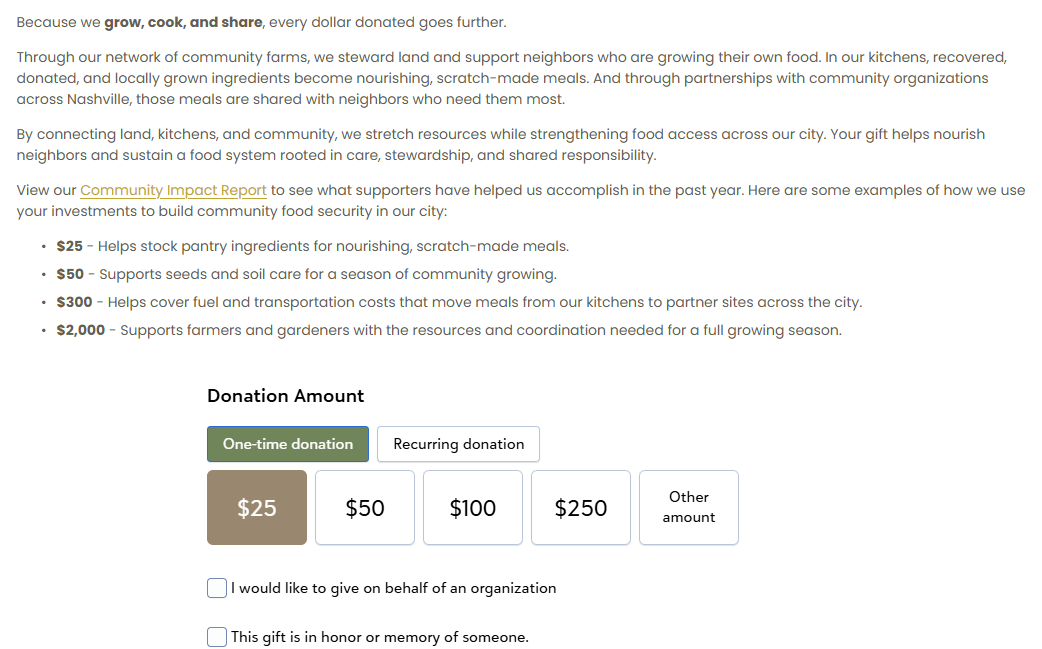
Connecting specific suggested donation amounts to concrete, descriptive outcomes helps supporters clearly visualize the exact difference their gifts make. Instead of presenting a generic payment field, outline precisely how your organization will use those specific funds.
For example, the Nashville Food Project features suggested amounts on their forms and describes the real-world impact of each level, making donors feel far more confident in their decision to give.
To maximize this emotional connection, pair these amounts with memorable photos of the people or causes you’re helping. The ASPCA successfully uses this tactic by displaying suggested giving tiers alongside a carousel of photos of the animals that donors’ contributions support.
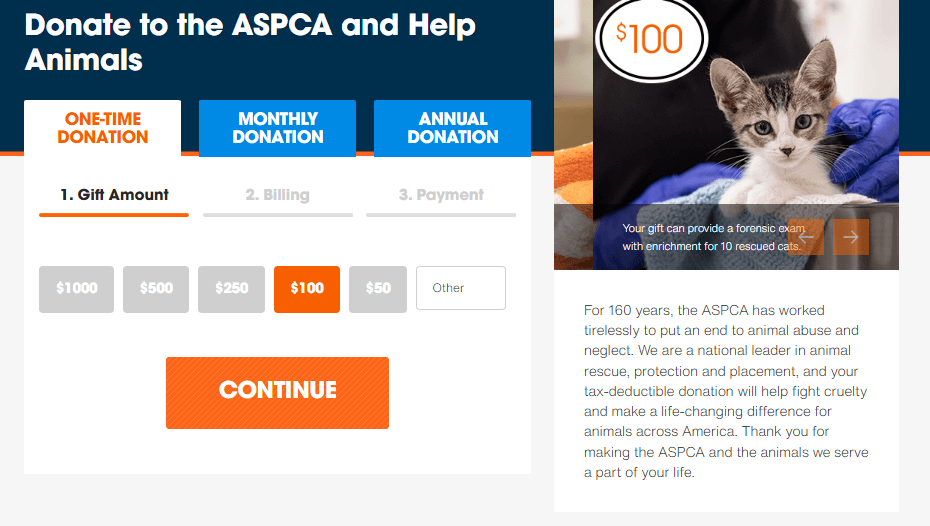
With this strategy, donors don’t have to wait until your follow-up email to understand the impact of their donations. They can see it up front, increasing the likelihood of giving.
Additionally, you can use AI solutions to further personalize the post-donation impact reporting process. As Bloomerang’s guide to AI for nonprofits says, “AI shines brightest when it’s helping you save time or make smarter, more informed decisions.”
When a transaction processes, an AI integration can pull the donation amount, date, and designated program from your CRM. It then crafts a customized message explaining the exact, tangible impact of that specific gift. A dry $50 receipt becomes: "Your $50 gift today just fully stocked a local family's pantry for the weekend." This personalized statement provides immediate gratification without requiring your staff to write hundreds of manual emails.
2. Ditch static compliance metrics for collaborative, process-based storytelling.
Cultivating deep credibility isn't about handing out bland financial statements, compliance reports, or auditing checkboxes. True trust is built when you welcome donors as valued insiders who are actively connected to your daily progress. By unifying your fundraising software, CRM, donor data, and volunteer management in a single platform, your team can easily tell a cohesive story.
To move away from internal organizational achievements and pivot to collaborative, donor-centric storytelling, try implementing these concrete steps:
- Conduct a “you” vs. “we” audit. Run your past appeals through your CRM’s communications audit tool. Count how many times you used "we" or "our organization" compared to "you" or "your support." Rewrite your communication templates to explicitly position the donor as the hero driving your mission forward.
- Send on-the-ground updates. Send brief, authentic updates directly from your programs, such as a short smartphone video from a volunteer site or a quick email about a mid-project milestone.
- Segment your storytelling. Use your database to match the stories you tell with the specific funds a donor supported. For example, if they gave to a specific housing initiative, tie the process-based updates they receive to that program's daily progress.
Swap out dry, institutional reporting for celebratory framing. Instead of writing, "Our nonprofit served 10,000 meals," shift to, "Together, you helped provide 10,000 meals last year!" This subtle shift allows you to celebrate collective wins with your community, building lasting partnerships.
3. Spark momentum and credibility with live campaign feeds.
Donors are far more likely to give when they feel your campaign has active, urgent momentum behind it. You can leverage social proof—the psychological concept that people mirror the positive actions of others—by making your community's active generosity highly visible.
Try these dynamic reporting strategies:
- Display interactive fundraising thermometers. Embed live goal trackers directly on your donation pages. This allows donors to instantly visualize the gap their support will close and exactly how their gifts help you cross the finish line.
- Broadcast dynamic donation feeds. For giving days, live campaigns, or hybrid events, project a live stream that lets supporters watch text-to-give donations and online pledges roll in in real-time.
- Feature live donor recognition pop-ups. Implement a recent activity ticker or subtle pop-up notifications (e.g., "Sarah from Atlanta just gave $50!") on your campaign landing page. This taps into community spirit and proves to hesitant donors that real people are actively trusting and rallying behind your cause right this second.
This instant, public validation proves to skeptical supporters that your mission is trusted and supported by a highly active community.
4. Cultivate agency and security through self-service portals.
A major driver of donor hesitation is a lack of control over how their personal data and financial commitments are managed. Building trust requires giving supporters agency and security throughout their giving journeys.
Cultivate a stronger sense of security for your donors by taking these steps:
- Keep them on your site. Reassure donors by embedding fully branded giving forms directly into your website so they don't have to navigate to unfamiliar third-party payment gateways.
- Explain your data usage. Clearly communicate why you collect their data and provide clear opt-out options for communications. For example, you might explain that you collect donors' email addresses to send prompt donation receipts.
- Launch a donor portal. Giving supporters the power to independently view their giving histories, manage recurring gifts, and update their credit card information reinforces your reputation for security and shows that you respect their boundaries.
Ultimately, when donors feel completely in control of their own data and giving experiences, their anxiety drops and their trust deepens. By prioritizing this level of transparent, self-guided service, you prove that your nonprofit values long-term supporter relationships over quick transactions—transforming a potentially skeptical, one-time giver into a confident, recurring supporter.
Donors give to people they believe in, and in a relationship-driven sector, trust is the true currency of generosity. When combating donor skepticism, move beyond basic transparency to build authentic, lasting human connections through comprehensive impact reporting.

Comments
Questions or comments? Join the conversation!